Showing posts with label Easter. Show all posts

Thursday, March 28, 2019

Worship: Are you Experienced?

I noticed that lots of churches today are calling their Sunday gatherings an “experience” rather than a “service”. Changing the names of doing things Christians have done for centuries is a peculiar characteristic of the American Protestant branch of Christianity.  It is one thing that unites both liberal and conservative Christians in this country. It probably has to do with the fact that the United States religious landscape is characterized by competition and we are all trying to get an edge to help our congregations grow.  I understand that changing the descriptor of worship from service to experience is usually done for evangelistic reasons.  The idea of having an experience may seem less threatening than performing a service to people who have demands on their time coming from all directions.

However, worship is the primary action of the Christian community, so we should really take a step back and ask ourselves, is this a good thing?  Does the word experience communicate what we are seeking have happen in our worship?  We should also ask the same question of service.  I would start by taking a looking at our sources and see what they say about what our worship should be. 

St. Paul gave a quick model for worship in his dialog with the Christians in Corinth: What should be done then, my friends? When you come together, each one has a hymn, a lesson, a revelation, a tongue, or an interpretation. Let all things be done for building up. 1 Corinthians 14:26 (NRSV)  So, is this experience, service or something different?

To the Christians in Rome Paul would describe worship in the following way: I appeal to you therefore, brothers and sisters, by the mercies of God, to present your bodies as a living sacrifice, holy and acceptable to God, which is your spiritual worship.  Romans 12:1 (NRSV) This one seems move us in the direction of service.   One doesn’t just attend worship but presents oneself as a sacrifice.  But still I think there is more than service going on.

In John 4, Jesus has a dialog about worship with a woman at well in Samaria: But the hour is coming, and is now here, when the true worshipers will worship the Father in spirit and truth, for the Father seeks such as these to worship him. God is spirit, and those who worship him must worship in spirit and truth.”  John 4:23-24 (NRSV) Do the words experience or service capture what Jesus is trying to communicate to this woman who was need of acceptance and healing?

If you asked me which term is more biblical overall, it would be the word “service”.  Forms of the Greek verb λειτουργια are used about 15 times in the New Testament and it can be translated as “to serve” or “offer service” and used on several occasions to describe worship.  The English word “liturgy” which traditional churches use to describe worship, is the loan word derived from this New Testament term.

Words that can translated to the English word experience occur 10 times in the New Revised Standard Version.  The King James only uses them 4 times.  No Bible translation uses the word to describe worship.  So, calling worship “an experience” is obviously a modern innovation.  That need not be deal breaker if we keep to the core of what our worship should be but does it?

My gut reaction to using the word experience to describe worship is a negative one.  The word is too passive.   It has connotations of entertainment and its goal seems selfish and unfulfilling.  It is too much like going to a concert or watching a movie and worship should be more.  Yet, I must admit that as a pastor one of the blessings in my current ministry is “experiencing” the ministry of our worship leader and team he has assembled to lead our congregation in song.  On countless Sundays over the years I have had to drag myself out of bed wondering how I could face the congregation I serve, only to have the worship inspire and encourage me to give. So yeah, part of great worship is the experience.

Even though the word service has a Biblical basis, I think it also is lacking.   Worship is not just about what I can bring to God, it is what God can do with, for, and to me.  If it is only about what we do, then worship can become drudgery.   Unfortunately, I have witnessed this happen when we in the church make too many demands of those who attend.   In summary, I suppose we should be careful about limiting the phenomenon of worship to the words we use to describe it or qualify it.

My choice for the congregation I currently serve is to let the word “worship” stand alone. I no longer use words like traditional or contemporary to qualify it.   Keeping it simple helps preserve the idea of majesty and even mystery.  For worship in Spirit and Truth that Christ describes will always be more majestic than our words.   Worship should be “an experience”, but remember we are saved for a purpose which means it should be a “service” to live out our call.   In all its unfathomable majesty worship should encourage, challenge, stimulate, comfort, heal, and all kinds of other things.   For indeed our best worship is when we meet and come face to face with the unfathomable God.

As we come into the church’s great season of worship, I pray that worship in your congregation may be so wonderful as to be indescribable.

Be blessed,
Pastor Knecht


Tuesday, March 27, 2018

Easter: the Victory of Faith

For whatever is born of God conquers the world.  And this is the victory that conquers the world, our faith! 1 John 5:4 

The Devil the World and Eroded Trust


If I would only look at the news,  I  would conclude simply that we live in a skeptical age. Seeing is believing we say, and even if we do see it, someone will question what it is we actually saw.   In our world today truth is said to be all in the numbers: poll numbers in politics, balance sheets in businesses (and yes sadly churches!) SAT or PARC scores in our schools.  Yet others will heap doubt upon those very numbers challenging that they don't really represent anything at all. 

Different camps will have different truths.  The savvy manipulator can go shopping for facts.  Institutions no longer have the credibility to mediate differing ideas and form consensus. The pressures of our current times have led us to doubt many things, if not most things.  If one goes with the flow of our culture there is little hope left in our world today.  Everything has an explanation, nothing is good or bad.  All is relative. Value neutral judgments rule from classroom to boardroom.  Unlike our ancestors who formed common ideas of virtue and vice, all has become utilitarian.   The left, right and center groups of culture are no different from each other in this regard.   All morality has devolved into self justification.   We are reliving the fall of Adam and Eve over and over again.  The serpents skeptical push rings in our ears, TV sets, and social media feeds.  If all become nihilists, the devil wins. 

The Real Alternative: Faith 


How different this is from what we are called to be by God in the witness of the Bible and through the moving of the Holy Spirit. We are reborn to be set apart from the wider world. It is not only OK to be different it is necessary.

Christians are called to be optimistic and hold certain virtues dearly.  Life matters from womb to tomb.  Each life has dignity,  We pay special attention to the lives of those beaten down by the world, and yes, even our enemies.  We are called to witness our faith in Christ, which as Christ modeled to us himself, means listening as much as speaking.  We hold that all are created good, even in the face of evil.

Our optimism is not the pie in the sky variety held used by marketers and prosperity preachers to get us to open our wallets or click the "buy it now" button.  It is the steadfast variety confirmed by scripture and witness, that the God who rescued Israel sent Jesus to redeem our world.  Our worldview starts with the premise that Christ and the good will ultimately triumph.  Indeed some will call us naive, but better to be pure of heart in the service of virtue and building things that last, than wise or worldly to merely satisfy our transient lusts.  When your life on earth is done, what side do you want to be on?  We indeed like Christ, may be called to pay a price, but that price will always be worth paying. The struggle may be long, arduous, and not all sugar coated, but the outcome is sure. Life will win! 

Easter Victory! 


How can we have the confidence to be optimistic in world so full or strife? Simple, listen to the Word of God that has upheld the faithful since Abraham.  In short, it says that God acts for good in our world at all times.  For us who follow Christ it specifically means that God sent his son born into this world just like we were so that we might be redeemed.  This redemption was done for us by Christ's sacrifice on the cross.  Three days after Jesus was put to death, he rose from the dead, destroying our last enemy and binding Satan underfoot.  This witness has been seen and handed down through the generations of the faithful.  Billions have experienced this truth in their lives and shared it with others. 

For us Christians, the watchword is faith,  the trust that God’s promises are actually for us.  This is grounded in the hope of resurrection. Our trust in Christ leads us to view our world differently than those who are skeptical or nihilistic.  For the faithful, the world is full of hope, as we see God working in all situations.  It is full of wonder, when the unexpected good comes along. It is realistic in the midst of crisis, but active in the midst of need.  It is humble when examining the potential of ourselves, but expectant when seeing God at work in the lives of others.  Our faith values love, justice and the intrinsic value of all life because we know that the only source of good is the God of life.  This we remember every Easter when we contemplate the empty tomb.

No, we have not conquered the old skeptical Adam within ourselves just yet, but by clinging to Christ we will not let the darker side of ourselves have supremacy.  So as Christians, we hold fast to our faith and the promise delivered at Easter.  May God strengthen your faith that you may always believe and have life in Christ's name. For he is risen indeed!

Blessed Easter 
Pastor Knecht 

Thursday, March 24, 2016

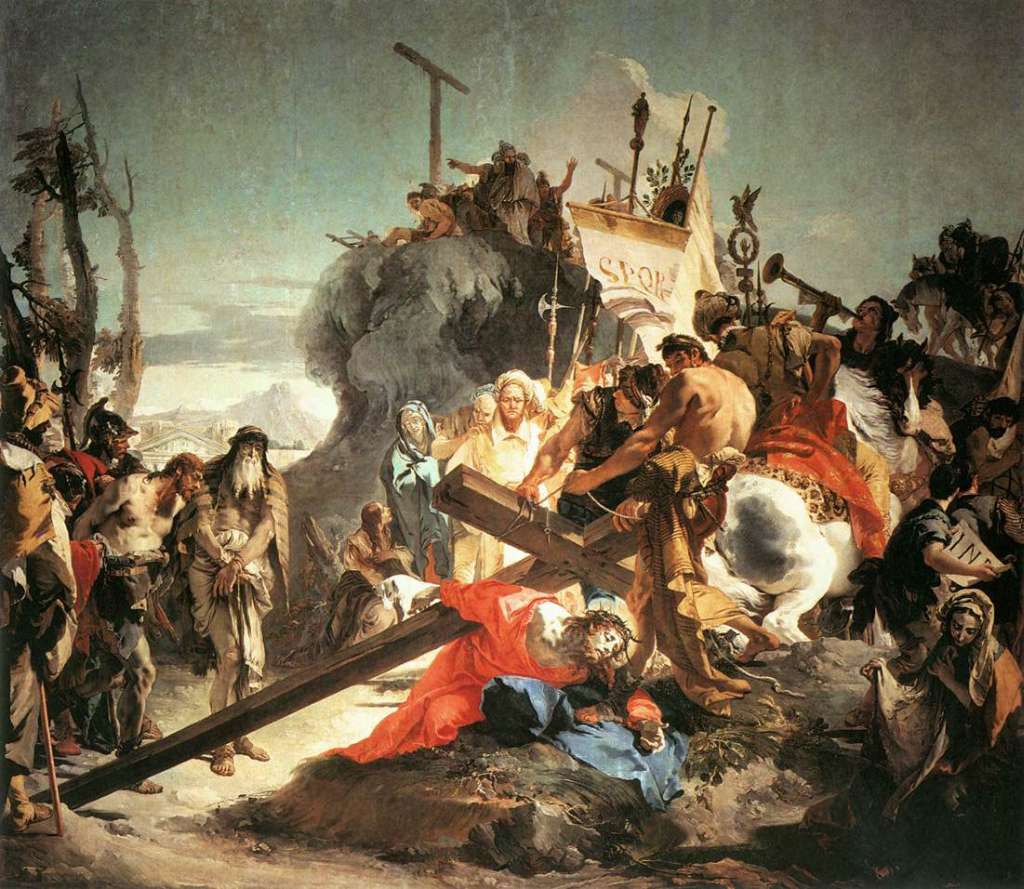
Who Bears My Cross?

Who bears my cross?  How we answer this question will reveal much about what we think about God,  the world and our own selves.  Perhaps you have an obvious answer or you struggle to figure it out. maybe you have never even thought about it.  This Holy Week and Easter I would like to wrestle with this question and see how different answers lead us in different directions.

Answer 1: Jesus Bears My Cross

Perhaps if God has gotten you through a tough time in your life recently this is your answer.   One looks at a situation that seemed impossible to overcome and yet by God's grace that person is still standing.  One realizes his or her limitations and relies on the power of God to make up for one's weakness.  The strength of this answer is that it can lead one to a powerful, daily, and living relationship with God.  

The problem with this answer is that Jesus specifically excludes it. 

Anyone who won't shoulder his own cross and follow behind me can't be my disciple. Luke 14:27(Message)

The way of Jesus Christ demands that we carry our cross behind him. In fact Jesus never tells us that he will bear our cross, he promises life eternal, forgiveness, healing, and hope, but not an escape.   There is a way that the statement "Jesus bears my cross" can be used to justify not living out one's faith at all.  One simply states "Jesus is my Lord and Savior" and "he took all my sins upon the cross" to justify a lack of transformation in one's life.   Then that one can go on living the way they always have.  

This answer can lead to a narcissistic focus on the self.  Jesus becomes our personal servant to bear any on the hard spiritual work we should actually be doing.  In this picture Jesus becomes "the help" and one barely knows his name and certainly little about what he is actually doing.   

Unfortunately, using the answer that Jesus bears my cross is good business.   It can be used to market a consumer friendly version of the gospel that makes no demands on life of the believer.   Just accept a few words as true and drop a few bucks in the plate is all they will ask.   This is what Diettrich Bonhoeffer called cheap grace,  grace bought and sold on a religious marketplace.  Seeing this picture in all its gory detail leads me to ask did Jesus really die for this? 

Answer 2: I Bear it by Myself

This answer seems to correspond to Jesus' call carry one's own cross in discipleship and follows the pattern Jesus himself set.   Jesus carried his own cross after all. 

Then he handed him over to them to be crucified. So they took Jesus; and carrying the cross by himself, he went out to what is called The Place of the Skull, which in Hebrew is called Golgotha. John 19:17-18 (NRSV)

The strength of this answer is that it does place accountability for the spiritual life back onto the shoulders of the believer.   One is taking up the cross head on.  One is making the changes in his or her life that should lead to transformation.  It confirms the truth of the the saying "we all have our cross to bear." It also recognizes the truth that Jesus' cross is different than mine. Jesus bore the sin of the world, I only bear an image of what he did.   

However,  as tempting to see this as the final answer it also has some serious weaknesses. If one focuses too much on our bearing the cross on one's own, one crowds out God.   Bearing the cross on one's own becomes a path to self righteousness.  It is all about what I do and not what God does. It also is over focussed on the self; the struggles of others have little meaning. This leads me to ask along with St. Paul the question "if I bear it myself then why did Jesus have to die?"  (Galatians 2:21) 

Answer 3: I Bear it with Help 

The simple fact of the matter is that when Jesus bore the cross he did not make it all the way on his own.   

As they led him away, they seized a man, Simon of Cyrene, who was coming from the country, and they laid the cross on him, and made him carry it behind Jesus. Luke 23:26 (NRSV)

Jesus the human couldn't do it all on his own, he needed the power of the Father and the help of others to carry the cross. This was all part of  God's plan to show us the way of salvation and peace.  A clue can be found on the night in which Jesus was betrayed when he gave a new commandment 

I give you a new commandment, that you love one another. Just as I have loved you, you also should love one another. John 13:34 (NRSV) 

We are limited sinful human beings we can not always bear our cross on our own.  One centered in the Gospel of Jesus Christ realizes that while one is accountable to carry one's cross and follow Jesus, we are not always able to do it, and sometimes we will even rebel from doing so.   I have noticed in the churches I have served over these 20+ years that often when I ask for a deeper commitment to Christ or the congregation someone will not able able to make it. 

Jesus realizes this and that is why he gave us the gift of church.  By this I do not mean the institution but the Christ centered Spirit filled organic community that is the Body of Christ.   We are called to help each other bear our crosses.  Yes we all have our cross to bear, but that does not mean that can't help each other carry them.   An individual can never separate his or her personal discipleship from the rest of the body of Christ.  We are connected to each other. 

When we focus exclusively on Jesus bearing the cross for us, or it's opposite, our carrying exclusively it on our own, we individualize and spiritualize the gospel.   When we realize that we are called to not only carry our own cross but to help each other along the way the gospel becomes more tangible.   My personal cross to bear has spiritual, physical, emotional, intellectual, and political hang ups.   When we bear each other's cross we get involved in the reality of our world because we get involved in the reality of our fellow children of God's actual lives.  

So this Holy Week and Easter I ask that we follow the advice of St. Paul: 

Bear one another's burdens, and in this way you will fulfill the law of Christ. Galatians 6:2(NRSV)

Be blessed, 
Pastor Knecht 


Wednesday, April 1, 2015

The Chaos of Holy Week and Hope of Easter

No,  I am not writing about how busy I am!   I am writing about how chaos plays a role in the story of Holy Week and Easter, with the hope that when your life seems chaotic you just might see God at work.

Kaos vs. Control

Control good?
During my childhood, the spy film parody Get Smart made fun of the cold war with the Soviet Union by describing a spy on spy battle between two international spy agencies KAOS and CONTROL.   The hero Maxwell Smart, agent 86, worked for CONTROL; his enemies such as the recurring character Siegfried, worked for KAOS.   The default assumption that control is good and chaos is bad, underlies how the characters are divided up into good guys and bad guys.  This should make sense, if you asked a person on the street their true feelings, control would be seen positively and chaos negatively by most people (there is always a minority of chaos lovers out there).

Chaos bad? 
One of my underlying assumptions about culture is that often the deepest issues of the human condition are not actually discussed in the places where they are intended to be discussed, but happen in places hidden in plain sight.  A satire like Get Smart can bring to light a deep issue in a way that we can laugh about it, and perhaps think about it in a deeper way later.

The battle between chaos and control happens in every human heart.  Too much chaos- life is stressful and dangerous.  Too much control- life is stifled and growth is impossible.  Our fear for survival may lead us with a preference for control,  but when things become too predictable life is robbed of any sweetness and joy.

Chaos vs. Control on the Road to the Cross 

Sometimes we confuse control with peace with disastrous results.   Too much need for control can lead us down unhealthy paths.  It can hurt those we are called to care for (like our kids).  It can rob all the joy from life.  Most of all, it reveals a complete lack of trust in God.

The gospel accounts show us that the fear of chaos leads Pontius Pilate to condemn Jesus to death unjustly and release a guilty man who actually caused real chaos that led to the death of innocents (Barabbas).  Fear of chaos led Jesus's enemies to conspire to have him betrayed in secret rather using legal means.   Judas' gut reaction to the unknown woman's chaotic act of anointing Jesus seems nudge Judas into betrayal of his master.  Pilate, Judas, and the leaders of the opposition to Jesus all want to do away him because he represents a potential chaos that brings change to the world they wanted to keep.  And they were right.

Jesus as Agent of Chaos 

The order of the world that Jesus came to change, was unjust and oppressive.   The Romans, Sadducees and Pharisees all had issues with being over controlling of others.  Jesus came to bring dignity and respect to those marginalized by the world.   He wanted every person to know they are God's child.  He died to set all free from sin and he created a whole bunch of chaos to get to the cross. I know many will upset by me describing Jesus as one who brought chaos but that is exactly how the Bible describes it.

On the road to Jerusalem Jesus eats and drinks with those he is not supposed to, touches and heals those who were ritually unclean. Jesus' entry into Jerusalem on Palm Sunday was certainly a chaotic affair,  then he heads straight to the temple and overturns all the tables of the money changers.  He then confounds Pharisee and Sadducee (liberals and conservatives) alike through his teaching.   He heals and forgives his enemies as they lead him to the cross, refuses to acknowledge the authority of Pilate to judge him, and questions God the Father.  When he dies the temple curtain is torn in two.   Matthew even talks of earthquakes and people coming back from the dead.

Why would the Savior of the world intentionally to cause so much disruption and chaos?

Chaos as the Stuff of New Creation 

My own personal faith story is that God used the chaos I was going through in my early twenties to bring me to a living faith in Jesus Christ.   The Holy Spirit called me from an old way leading to death to a new way leading to life.   I was open to listen because my life was a chaotic mess.   God used chaos to bring about something new and better.

This is how God has worked since the beginning of space and time.

Genesis 1 tells us that the earth was formless and void, which Biblical Scholars of the Hebrew Bible have been telling us for a long time was an idiom meaning a "chaotic mess".   God calls forth light and then uses the stuff of chaos to create the universe.   The meaning is simple,  chaos is a tool that God can use to bring new life.   Jesus used the chaos of holy week to make a new creation, which includes all people in a promise of salvation.   The chaos he created overthrew the tyranny of sin, death, and the devil.


If you are going through a chaotic time now, please know the promise of the resurrection in Jesus Christ.  God can use it to bring you to something new better.   God is not only stronger than chaos, God can use it to bring you to new life.   Please let me be clear,  I am in no way advocating one seek out chaos.  Real chaos happens on its own, and seeking it out doesn't sound healthy or faithful to me. However, if you are going through something really terrible now, please know that God can use even this to bring you life and hope.   God loves you so much he will use every tool at his disposal to bring you new life.    We need not be held in bondage to fear of an unpredictable future or the possibility of an unbearable present, because we have a God who can use all things to love us.

He is Risen!

Be blessed,
Pastor Knecht

Wednesday, April 16, 2014

Technology and Resurrection

Artificial Intelligence (AI) & Immortality 

I am sure by now you are aware that all types of data is being collected on each person everyday.    The news is rife with stories of privacy issues, data breaches and eavesdropping.  Every time you visit a website, purchase products online (or just with a credit card in a store),  rate or write a review of something, or click that harmless looking thumbs up button on Facebook or Pandora that data goes somewhere.  On top of that wearable tech such as Google Glass and the Samsung Dick Tracy watch are in their prototype stages.     Will these be collecting other types of data?  Could they be used to capture emotions and reactions to events and record them with the images the camera is collecting while tracking your location?   If so, could someone then collect all his or her data and use it to create a realistic profile of her or himself.    Could that profile then be combined with a process of artificial intelligence to create a newly regenerated virtual person?   Can this person then be downloaded into a piece of tech that can communicate and interact with the world?  If the answer to these questions is yes, have human beings found a way to be immortal through their own devices?

Not yet, but people are actually working on these very types of things.

Hell 

The whole problem with this is, that if we can construct an immortal life through our own efforts we would be simply carrying our broken pasts into a dark future.   The traumas lived through would be carried on into eternity.  There would still be pain, there would still be loss,  there would still be evil.   These experiences of our sinfulness wear us down and tinge our lives with sorrow.   As we carry these burdens forward, time itself would loose all meaning,  there will be no urgency to do anything, experience would pile upon experience.   We would find that we were not damned to hell, but that we had created it ourselves for all eternity.   It is the reason why the Bible portrays God as expelling Adam and Eve from the garden of Eden. (Genesis 3:22) Then the LORD God said, "See, the man has become like one of us, knowing good and evil; and now, he might reach out his hand and take also from the tree of life, and eat, and live forever"--  (NRSV)  This was not done out of spite or punishment, but as an act of grace so that no person would be condemned to unending suffering.


Forgiveness and Hope


While we may know the hope we have from a life of faith is an eventual eternal life,  it is not the first hope we have.  For the hope we have in Jesus Christ is first and foremost grounded in forgiveness.   Forgiveness breaks the cycle of evil that has been built up in our lives over time.   It heals the relationships we have with God, others, and the division within our own hearts.   If not forgiven, we can not be healed, if not healed we are not prepared for eternal life.   It is why when God sent Christ to the Cross it was first and foremost and act of forgiveness.   Jesus would show his wounds to his disciples to prove that he had forgiven them.   That the pain of Good Friday could be reconciled, proved that God can reconcile any division imaginable.   If you don't think that one really needs forgiveness to live eternally,  do this experiment.   Review the major news stories of the last week,  count how many are tragic or even evil.   Then take that number and multiply it by 52 and get an idea of how much pain just one year exists in an broken world.  Then think about that going on year after year with out end.   Unless the cycle is broken there will be no hope; it is the ultimate blessing for us that God has chosen to break the cycle of sin with the cross of Christ.  

Living out that hope in tangible ways is what we call discipleship.  True disciples don't wait for the forgiveness to appear in some distant future, they work on it now.   By advocating for the vulnerable, feeding the poor,  encouraging the downtrodden, we provide signs of hope that point people to a God who wants to heal, restore, and forgive.  In a life of Christian discipleship the best way to use technology going forward will be to use it as a tool of discipleship to do Jesus' work of being there for the least of the world.


Isaiah and the LORD's Mountain

One of the earliest references to resurrection in Scripture is comes from  the prophet Isaiah.   He gave us this vision of hope:  (Isaiah 25:6-8) On this mountain the LORD of hosts will make for all peoples a feast of rich food, a feast of well-aged wines, of rich food filled with marrow, of well-aged wines strained clear. And he will destroy on this mountain the shroud that is cast over all peoples, the sheet that is spread over all nations; he will swallow up death forever. Then the Lord GOD will wipe away the tears from all faces, and the disgrace of his people he will take away from all the earth, for the LORD has spoken.  (NRSV)  Notice that God does not just give the eternal life alone.   The promise is for the removal of tears (pain) and disgrace (shame).   Before these gifts are mentioned, Isaiah speaks of God destroying the shroud.   The removal of the shroud or sheet is the removal of the division between God and people, it is this removal that makes a blessed eternal life possible.  It is forgiveness that gives us hope.    So as we live out the greatest three days in history, perhaps it is most healthy to move beyond a childlike desire to merely live forever to mature faith that hopes for forgiveness.

May all have a happy and blessed Easter

Pastor J. David Knecht

Wednesday, March 20, 2013

The Whole Story

Remember how he told you, while he was still in Galilee, that the Son of Man must be handed over to sinners, and be crucified, and on the third day rise again.” Luke 24:6-7

On Sunday we begin Holy Week;  it is the culmination of our Lenten season, which is a time to get back to the basics and origins of our faith.   In Holy Week we set aside the time to breathe in the whole story of the suffering death and resurrection of Jesus.   We take the time as a whole community to remember the story in its entirety together with Christians of all groups and denominations around the world.   We tell each other the story of life and salvation centered in the saving acts of Jesus.  What I am asking you to consider this Easter is to try to take in the whole story.   For each part of what we remember this week is vital to your relationship with the living Christ.   


The story begins with Palm Sunday,  it sends a clear message that Jesus is worthy of our praise on the one side, and that our praise will never be sufficient on the other.   We learn that sometimes our expectations of what we think God should be doing can get in the way of perceiving of what he is actually doing.  The people who spread their cloaks and palms expected a new political leader to come along and fix the worldly system to their liking.  When it becomes clear that that is not what Jesus is all about, they all turn on him.  


As we come to Thursday we see that there is a limit to all people's faithfulness.   The disciples can not stay awake in the garden,  Judas betrays,  Peter denies, the rest run away (one even losing his clothes according to Mark).  This tells us that our fallible human faith does not have the power to save, but that God's grace alone offers us the only chance at true salvation.   Without God's power to carry us through we can never be strong enough to make it.   We understand that God responds to human weakness by sending his grace.  


Jesus sends this exact signal on the night he is betrayed as he leaves us with the gift of his supper, the example of his washing the disciples feet, and the commandment that we love as he has loved.   It is also the night that he promises the gathered of the coming of the Holy Spirit to strengthen our faith with the love and comfort of God so that we can make it through all the adversity that life can at times bring.   We come to see that even in the darkest hour God can bring grace to bear on behalf of all his children even when they not proved worthy of it.  


Friday seems as if it is the darkest day.  Humanity rejects the one sent to save it.  Jesus is mocked and nailed to the cross so we humans can maintain the illusion of our own power.  The Romans want to show everyone who is boss to quash any future rebellion against their tyranny. The religious establishment will bear no challenges to its prestige in society.  The angry mob wants another freak show so it can laugh, mock and degrade to fill its lust for entertainment.  So Jesus must go, no matter that he is innocent.  If this is all there was, it would be a dark day indeed,  but at this precise moment we learn that God loves us so much that he is willing to enter into humanity completely, even at its darkest and most vulnerable.   He yells a quote from Psalm 22 " My God! Why have you forsaken me".  The temple curtain is torn in two and the gap between man and God is bridges fully in the person of Jesus.  So this day is good.  We learn we can become a new creation in Christ and move through death into life.  


Sunday is the Lord's day. The new creation is  complete.  The victory over sin, death and the devil is accomplished. Jesus is risen!  We are given the hope of life with God for eternity.  The story is at times too wonderful for those hurt by the world to dare to believe.  So Jesus' resurrection takes a little time before it sinks in the hearts and minds of the disciples.   It is why the angel says the quote at the top of this page.  It is also why Jesus takes the time to tell the whole story to the disciples on the road to Emmaus in Luke 24.   The disciples then recognize Jesus in the breaking of the bread.  They speak  also about how speak about how their hearts were burning as Jesus was bringing them the whole story of what was going on through God’s gift of the scriptures.


In order to give your life completely to Christ you must also try to grasp the whole story.   Sunday has meaning because what happened the previous Friday.   Friday was necessary because of what went on earlier in the last week of Jesus' life.   This is indeed the greatest story ever told, so don't settle for only a part of it.   Each aspect of the story of Jesus touches a different aspect of your life of faith, and we can grow in that faith when we take the time to concentrate on the different aspects and implications of the various parts of the story of Jesus' passion and resurrection.   It is not a collection of stories woven together, but the one true story begotten by the grace of God.  I pray that you find peace this season by taking it in and working through it.


May you all have a happy and blessed Holy Week and Easter


Keep the Faith
Pastor Knecht